
Last week we sorted out which account to use. The next question, and arguably the more important question, is: what should I actually invest in?
The financial industry wants to make it look complicated, but in reality it shouldn't be. And I'll explain why.
The main building blocks
A few basic types of investment make up almost everything you'll come across.
Cash and GICs are the safe end. A GIC, or Guaranteed Investment Certificate, is where you lend a bank money for a set term, say one or three years, in exchange for a fixed interest rate, with your money guaranteed. The trade-off is a low return. These suit money you'll need soon, not money you're growing for decades.
Bonds sit in the middle. A bond is a loan you make to a government or a company, and in return they pay you interest over time. Bonds are steadier than stocks and pay a modest return, which is why they're often used to take some of the bumpiness out of a portfolio.
Stocks are the growth end. A stock is a small piece of ownership in a company, so when the company does well over time, so do you. Stocks have produced the best long-term returns of the three, but they also move up and down the most, sometimes sharply, which is why they're meant for long horizons.
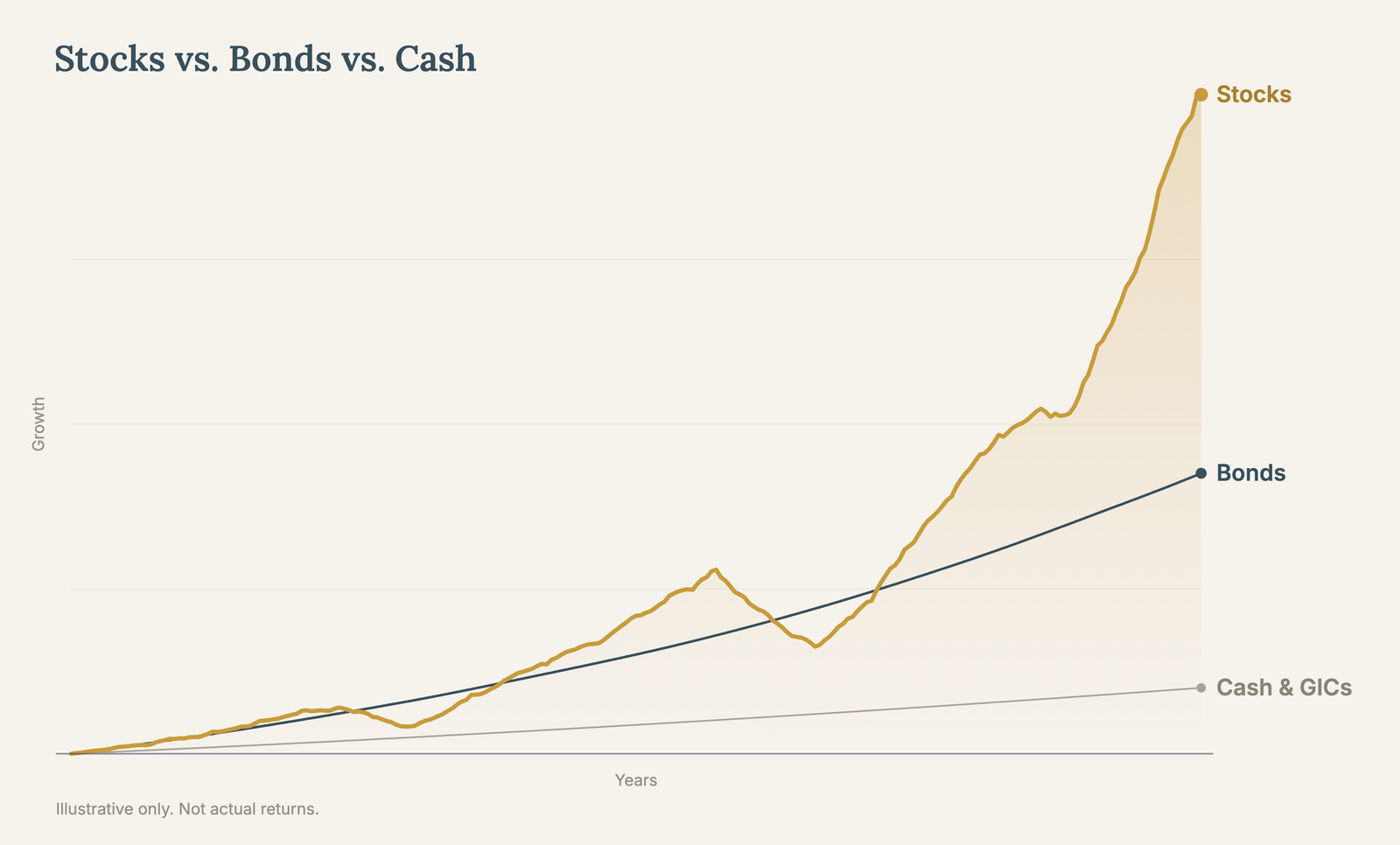
Most portfolios are some mix of these, weighted toward stocks when the goal is far away and toward bonds and cash as it gets closer. These are the things that go inside the accounts we covered; the account is the bucket, and these are what you fill it with.
One stock, or all of them?
Once people decide they want stocks, the next instinct is often to pick a few companies they believe in. That's how I started. I bought individual stocks, Canadian banks, a couple of oil companies, a few tech names, and read the Motley Fool looking for the next winner.
What I came to realize is that picking individual winners is incredibly hard, even for professionals, and that a single bad pick can wipe out years of gains. So I stopped trying. Instead of betting on a handful of companies, I started buying all of them at once through an index fund.
What an index fund is
An index fund is a single fund that holds every company in a market index, like the whole Canadian market or the whole U.S. market, in one purchase. Rather than guessing which companies will win, you own a slice of all of them, so you earn the market's return instead of betting on beating it.
Two things make this the default starting point for most beginners. You're instantly diversified, because your money is spread across hundreds or thousands of companies, so no single one can sink you. And index funds are cheap to own, often a tiny fraction of what a traditional mutual fund charges, and cost is one of the few things that reliably predicts what you'll keep.
Most index funds today come as ETFs, or exchange-traded funds, which just means the fund trades like a stock and you can buy it in any brokerage account.
But isn't picking stocks how people get rich?
It's a fair question, because the big winners get all the attention. Someone always bought the right stock at the right time, and their story gets told. What you don't hear about is the far larger number who tried the same thing and lost, or who simply trailed a boring index fund while taking on much more risk and stress.
For me, it came down to the odds. I concluded they weren't in my favour, and that owning the whole market gave me a better expected result with a fraction of the worry. That's a trade I'll take every time.
What's next
Index funds win largely because of cost, and because most professional stock-pickers don't beat the market once their fees come out. That claim deserves its own post, so next week we'll look at why most active funds lose to a simple index over time. You can run your own numbers anytime with the calculators at smallbirdfinancial.ca.
This is general financial education, not individual advice. The right mix for you depends on your goals and timeline, so talk to a qualified professional about your own situation.
Get new posts by email
Subscribe to The Smallbird Brief and I'll send new posts straight to your inbox.