
Last week we went through the order screen and got the first purchase done. That is the part people are afraid of, and once it is behind you the risk changes shape. One purchase is not a portfolio. What builds a portfolio is the same small decision repeating for thirty years while you are busy thinking about other things, and the reason that turns out to be hard has almost nothing to do with knowing what to buy.
Willpower is the wrong thing to build on
Most investing plans are designed to need a decision every single month. On payday you have to remember, look at the balance, decide whether this is a good month to put money in, and then go and do it. Miss it twice and the habit is gone, and it tends to go during the stretch when you are busiest or the news is worst. Nothing about that is a discipline problem. Willpower is finite for everybody, so a plan that spends some of it every month runs out for most of us eventually.
What works better is moving the whole decision to one afternoon and then never making it again.
Set the transfer
A pre-authorized transfer moves a fixed amount out of your chequing account and into your investing account on a schedule you set once. Every Canadian brokerage supports it, it costs nothing, and it takes about five minutes. Set it for the day after you get paid so the money is gone before you have had a chance to build a month around it.
Pick the amount you are confident you can hold through a bad month, not the biggest one that fits on a good month. For reference, $269 every two weeks fills a TFSA to the 2026 limit of $7,000 over a year. If that is out of reach right now, $50 is a real system and $500 is not one if you have to cancel it in March. You can raise it later, and raising an amount is far easier than restarting a habit.
Moving the cash is only half of it
The transfer gets money into the account, where on most platforms it sits as cash until somebody places an order. There are people carrying several thousand dollars of uninvested cash in a TFSA right now because they did the hard part and skipped the easy one. Some platforms will close that gap for you: Wealthsimple, for one, lets you set a recurring investment that buys an ETF you have chosen on a weekly, biweekly or monthly schedule, in a TFSA, an RRSP or a non-registered account. If yours does not do that, put a recurring reminder in your calendar on transfer day and treat it as a two-minute chore rather than a decision. You know the order screen now.
You probably do not need to rebalance
Rebalancing means selling a bit of whatever grew and topping up whatever lagged, so your mix comes back to the target you picked. If you own a one-ticket ETF like XEQT or XGRO, the fund does that inside itself, on its own schedule, and you never touch it. That is a good part of why one fund is enough for most people.
If you hold separate funds instead, pick one date a year, look at the split, and move it back if it has drifted more than about five percentage points from where you wanted it. Once a year is plenty. Checking more often mostly hands you more chances to talk yourself into something, and the mix you are checking against is the one from the asset allocation page, not the one that would have done best last quarter.
What to hold onto when it drops 20%
At some point while you own it, the market is going to fall a long way, and that is a certainty rather than a risk you are running. A 20% decline is an ordinary event across a thirty-year holding period, and you should expect several of them plus one or two considerably worse. What makes those stretches expensive is the arithmetic of getting back: a 20% drop needs a 25% gain to return to even, a 30% drop needs 43%, and a 50% drop needs the market to double. Sell on the way down and you take the loss, then stand outside for the recovery that would have fixed it.
Losses also feel bigger than the equivalent gains, roughly twice as big in the behavioural research, which is a rule of thumb rather than a constant. Anybody who has held stocks through a bad year already knows this without the citation. A 20% drop does not land as the mirror image of a 20% gain. It lands as an emergency.
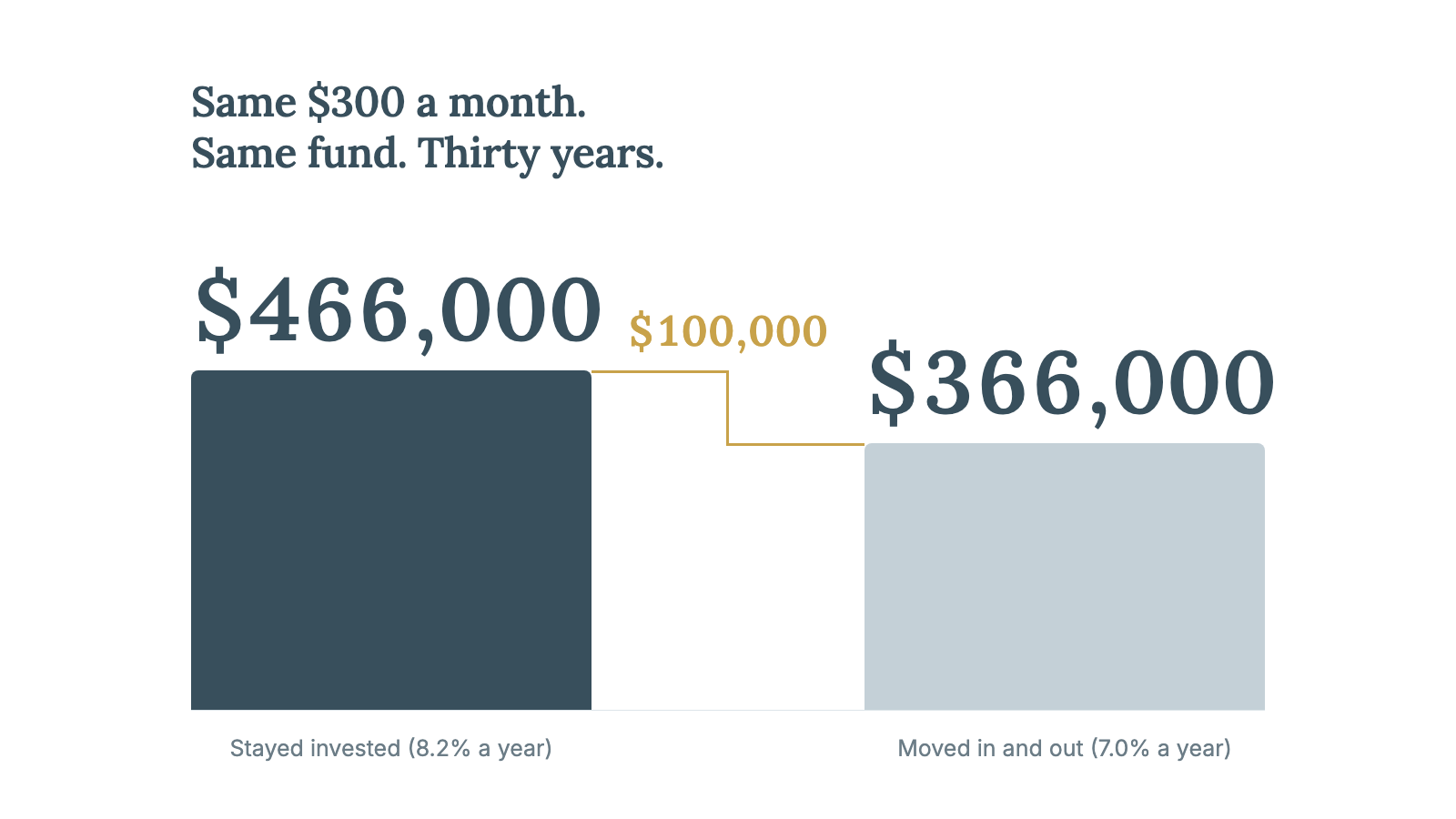
Morningstar puts a number on what acting on that feeling costs. Their 2025 Mind the Gap study looked at the ten years ending December 31, 2024, and found the average dollar invested in US funds and ETFs earned 7.0% a year while the funds themselves returned 8.2%. The 1.2-point difference is entirely the timing of money going in and coming out. The most useful finding in it is where the gap was narrowest: investors in one-ticket balanced funds captured about 97% of what their funds returned, because there is nothing inside one to tinker with.
Over a full career that 1.2 points adds up to a serious amount of money. Three hundred dollars a month for thirty years at 8.2% comes to about $466,000. The same $300 at 7.0% comes to about $366,000. Same money in, same fund, and roughly $100,000 of difference produced by nothing except when people moved. I am projecting a ten-year US measurement across thirty years there, so read it as a sense of the size of the problem and not as a forecast.
Write your rule before you need it
The only thing your system asks of you in a downturn is that you leave the transfer running. That is the whole ask. The automatic contribution keeps buying while prices are down, which is the one part of a bad market that works in your favour, and it does that without you having to feel brave about it on a Tuesday morning.
Write your rule down now, while nothing is going wrong, because that is the only time you will write a good one. Mine is that I change my mix when something changes in my life, and never because of what the market did. That is why I moved my own FHSA into 60% XEQT and 40% XSB. No forecast involved. We are buying a house within about five years and the timeline had shrunk enough to matter. A timeline is a reason. A headline is not.
Your one job each year
Once the transfer is running, the yearly maintenance is genuinely small. Pick a date you will remember, your birthday or the first Saturday in January. On that date, check your contribution room so you do not go over the limit, and the TFSA room calculator will do that arithmetic for you. Raise your contribution by however much your income went up, then confirm the mix still fits your timeline. Close the tab and go do something else.
The raise is the one on that list worth setting a reminder for on its own. A contribution that grows with your pay will do more for your final number than any fund you could have picked instead, and it is the only lever in the whole system that gets stronger as you get older.
Where this leaves you
Twelve posts ago the question was why to invest at all, and the answer this series has been building toward is a low-cost fund bought automatically, in the right account, at a mix that matches your timeline, then left alone through the years that feel bad. It is not clever and it was never supposed to be. The whole point of a system is that it keeps working on the days you are not thinking about your money, which is most of them.
If you have been reading along and have not set anything up yet, the transfer is the one thing worth doing this week. Five minutes, one screen, and the rest of it runs itself.
More posts are coming, and if there is a question this series left unanswered for you, I would like to hear it. That is usually where the next one comes from.
This is general financial education, not individual advice. I hold some of the funds mentioned. Platform features and contribution limits change over time, so confirm current details with your brokerage and with CRA. For advice specific to your situation, talk to a qualified professional.
Get new posts by email
Subscribe to The Smallbird Brief and I'll send new posts straight to your inbox.