
Last week we worked out your split between stocks and bonds. Now it has to become something you own, which means sitting down and buying it, and this is the step where people stall for months. The screen looks dangerous, and nobody wants their first move to be the wrong one.
My own first order was a single share of Enbridge, bought when I was 19. I sat there looking at the order type box with no idea whether market or limit was the right answer, half convinced that picking wrong could cost me everything I had put in. That was one share of a Canadian pipeline company. It went through, nothing happened, and the nerves turned out to be the most expensive part of the whole exercise.
Waiting for a better moment costs more than choosing the wrong box ever will. So start small enough that being wrong doesn't matter. Take $20 and buy your first investment. I recommend this over any other first step, because at $20 there is nothing to overthink: you stop trying to get the decision right and just learn how placing an order works. You will learn more from one real $20 order than from another month of reading about it, and you learn it without anything meaningful on the line.
Every field on that screen has a plain answer, and only two of them change anything for someone buying a one-ticket fund and holding it. Here is what each one is asking.
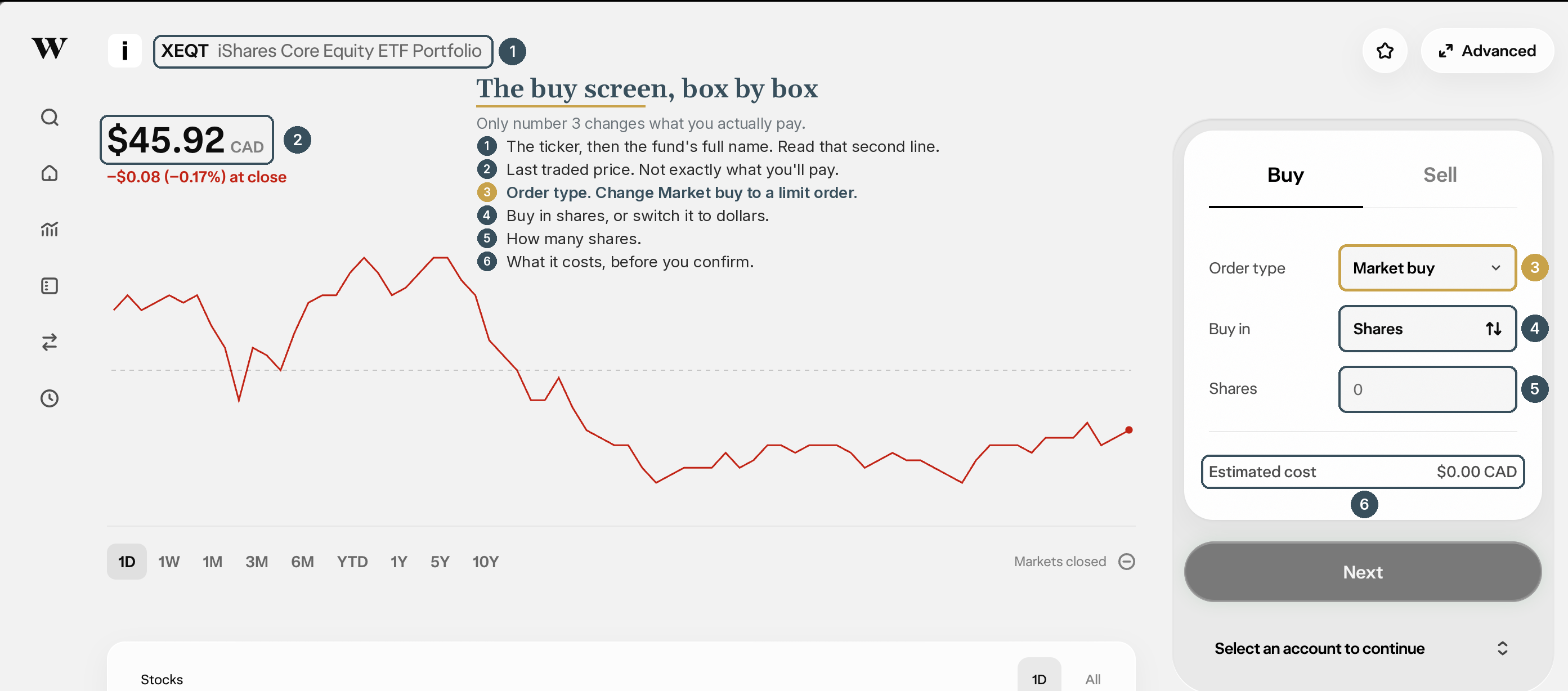
The ticker box
The first box wants the fund's ticker, the short code that identifies it on the exchange, like XEQT or VGRO. Type it in and the full fund name should appear underneath, and reading that line is worth the two seconds it costs you. Search results mix Canadian and US listings together, and a US-listed fund bought inside a Canadian-dollar account gets your money converted on the way in at a rate you never shopped for. If you took your fund from my asset allocation page, the ticker listed there is the Canadian one.
Market order or limit order
The order type box gives you two choices, and they behave very differently the moment the price moves. A market order says buy it now at whatever the going price is. A limit order says buy it, but not one cent above the price I name.
I use a limit order on every buy, whatever the amount, and I set the limit a few cents above the current price. It fills right away, the way a market order would, because the price I'm willing to pay is above what sellers are asking. The limit is a ceiling. If the price jumps while my order is travelling, it catches the jump instead of my account.
A market order has no ceiling on it at all. On a heavily traded fund like XEQT the difference is usually a few cents, and on a quieter fund or a fast morning it can be more. The protection costs you nothing, so there is no good reason to skip it.
How many shares
Quantity comes next, and the box you get depends on your brokerage. Questrade lets you enter either a dollar amount or a share count and fills in the other one for you. Wealthsimple asks for shares, with a Max button that spends everything available in the account. Either way the arithmetic is the same, your money divided by the price per share, rounded down to whole shares unless your platform sells fractions.
You will almost always have cash left over in the account afterward, and that is normal. If your fund is trading around $45.92 and you have $500 in the account, you get 10 shares for $459.20 and roughly $40 sits there. Almost nobody's account divides evenly.
Some platforms now sell fractional shares, which removes the problem entirely. Wealthsimple lets you buy part of a share, so the whole $500 goes in and nothing is left stranded.
If yours only deals in whole shares, what you do with the remainder comes down to what an order costs. Where trades are free, place a second small order and put the rest to work rather than letting it sit. Wealthsimple and Questrade both charge $0 commission on stocks and ETFs, so that second order costs you nothing. Most of the big bank platforms still charge per trade, and TD's own commission schedule lists $9.99 for a standard trader, which is not worth paying to move $40. There, leave the cash where it is and roll it into next month's buy.
Quotes on the TSX are built around board lots of 100 shares for anything trading above a dollar. Nearly every first order is smaller than that, which makes it an odd lot, and odd lots get filled at the best price across all the markets a fund trades on rather than the single quote you happened to be looking at. It's a reason your fill can land a cent off, not a reason to go buy 100 shares.
Why the price you saw isn't the price you paid
The big number on the fund's page is the last traded price, which is what the most recent completed transaction went through at. It's history. What you'll pay is the ask, the lowest price anyone is currently willing to sell at, and what you'd get selling is the bid, the highest price anyone is currently willing to pay. The gap between the two is the spread, and on the large one-ticket funds it's small enough that most people never notice it.
Wealthsimple shows the bid and ask under the performance graph, and the bank platforms show them on the quote window. Look at them once, on your first order, so the fill price makes sense when it lands. After that you can ignore them for the rest of your investing life.
How long the order stays open
Some platforms add a field asking how long the order should stay open, and Day is almost always the default. Day means it expires at the close if it hasn't filled. Good till cancelled keeps it alive for weeks. For a limit order set just above the current price, Day is the right answer, because the order fills in seconds anyway.
Orders placed outside market hours don't vanish, they queue. The TSX runs 9:30 to 4:00 Eastern on weekdays, so anything you submit at eight in the evening waits until the next open. That is normal, and it's a common reason a new investor thinks their order failed.
After you hit submit
Every platform keeps an orders list, and yours will move from submitted to accepted to filled, usually in about the time it takes to read the confirmation. Questrade shows it in a table under the chart. Once it fills, the shares appear in your holdings and the cash comes out.
A partial fill means some of your shares went through and the rest are still waiting. It's uncommon on a fund this widely traded and it isn't a problem. You own what filled, and the remainder either fills a moment later or expires at the close and you place it again.
The trade then takes one business day to settle, which happens in the background without you doing anything. You own the shares from the moment the order fills.
Start smaller than feels serious
I said $20 at the top and I meant it. Five or ten dollars a week is a real order too, and what it teaches you is how it feels to watch your own money move up and down without touching it. That feeling is the actual skill, and no amount of reading hands it to you. Even in the wrong fund, ten dollars a week will not change your life. The habit is what you're buying.
I use Wealthsimple for all of my own banking and investing and think it's an excellent platform, and most of what it gives you is free. Keep your guard up about one thing while you're in there. They have also started pushing options trading and crypto pretty hard, and it shows up on the same screens you're using to buy an index fund. That is where their profit has to come from, because it isn't coming from commission-free ETF trades and no-fee chequing accounts. You can enjoy the good parts and leave that alone.
Where to go from here
The exact taps differ from platform to platform, so there's a walkthrough for each of the seven big ones on the site: Wealthsimple, Questrade, TD Direct Investing, RBC Direct Investing, BMO InvestorLine, Scotia iTRADE, and CIBC Investor's Edge. They're also linked from the asset allocation page, right beside the fund you're buying.
What's next
Placing the order once is the hard part, and doing it again next month without thinking about it is what turns a purchase into a portfolio. Next week we'll go through building the system around it, the automatic transfer that removes the decision, and what to hold onto when the market drops 20%.
This is general financial education, not individual advice. I personally hold some of the funds mentioned, and brokerage screens and fees change over time, so trust your platform's current help pages over these steps. I have a Wealthsimple referral link on my resources page, which is the only connection I have to them beyond being a customer. For advice specific to you, talk to a qualified professional.
Get new posts by email
Subscribe to The Smallbird Brief and I'll send new posts straight to your inbox.