
Last week laid out the vocabulary, including CPP, OAS and GIS. In this post, we'll walk through how much money to expect from those programs. These programs make up the base of every Canadian's retirement, so it's important to know how much we can expect from them. When people talk about CPP and OAS, many quote the maximum, but as this post will explore, the maximum is not usually the case.
CPP pays less than most people assume
As of January 2026 the maximum CPP retirement pension at 65 is $1,507.65 a month. The average one being paid, as of April 2026, is $877.01.
The average is 58% of the maximum, and reaching that maximum takes roughly 40 years of earning at or above the year's ceiling, which most people never manage. Years in school, years raising kids, part-time stretches, a bad year, self-employment where income dipped, all of it pulls the number down. CPP does drop your lowest-earning years out of the calculation, and most people still land well short of the headline.
If you were the primary caregiver of a child under 7 and earned little or nothing during those years, the child-rearing provisions can keep those months from pulling your pension down. They are not automatic. You have to ask for them when you apply for CPP, and it is an easy step to miss.
So when you read that CPP pays about $1,500 a month, that is the ceiling. The going rate is closer to $877.
OAS is the other half of the floor
Part 1 covered how OAS works: based on residency rather than earnings, available from 65, nothing contributed by you. For the July to September 2026 quarter it pays up to $751.97 a month between 65 and 74, and 10% more, $827.17, from the month you turn 75. That increase is permanent, and the clawback described last week only reaches a small number of people.
Adding the floor up
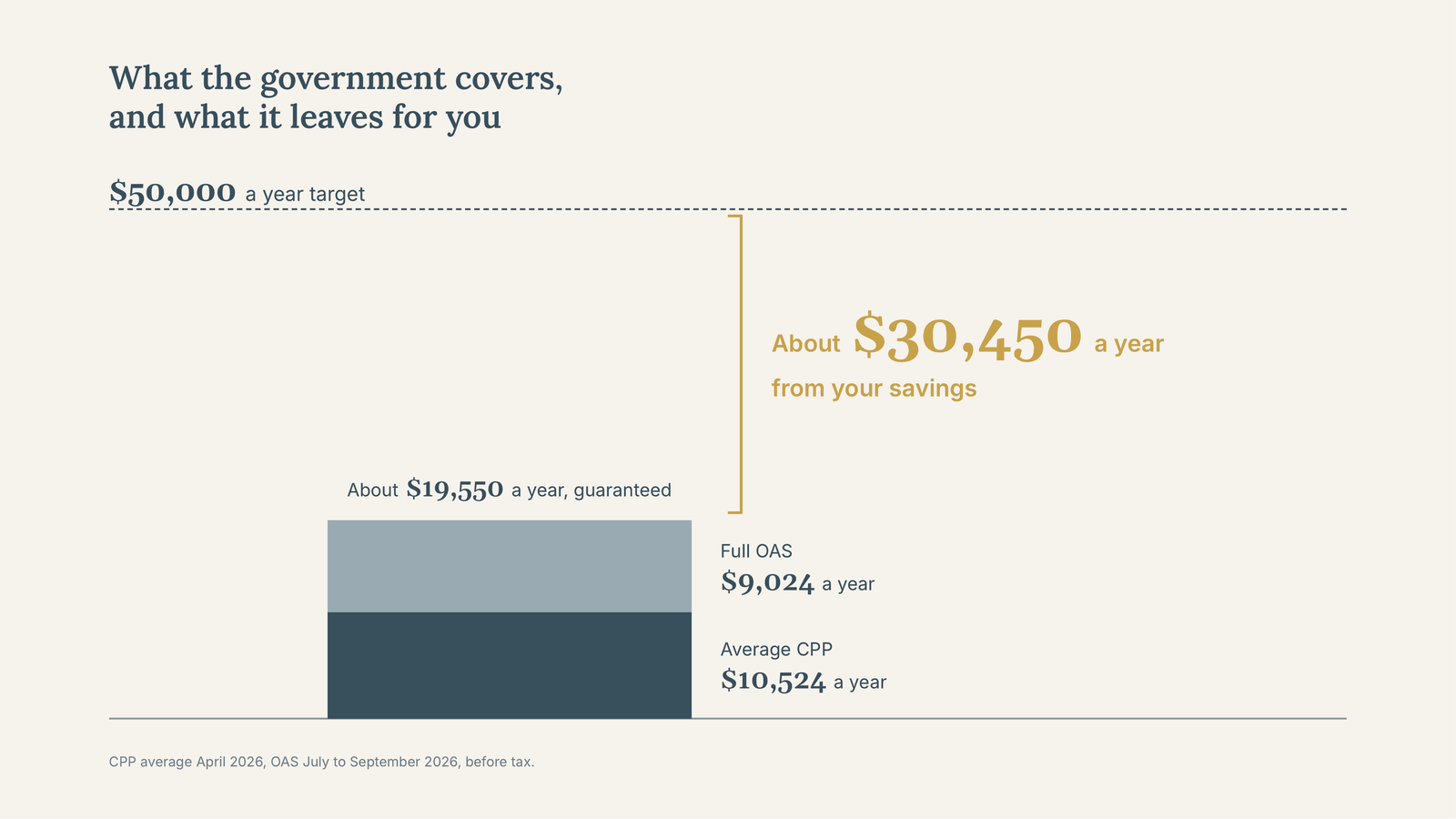
An average CPP plus a full OAS is $1,628.98 a month, about $19,550 a year, and someone who earned at the ceiling for a full career gets $2,259.62 a month, about $27,100. Both are before tax and are indexed to inflation for life.
Nineteen and a half thousand dollars a year is not a retirement, but it is not nothing either. It arrives every month whether your portfolio had a good decade or a bad one. And it is extremely unlikely to run out. Canada has one of the most stable pensions in the world. If your whole plan fell apart tomorrow, that floor is still there at 65.
For people whose retirement income is low there is a third layer. GIS tops up OAS by as much as $1,123.17 a month for a single person with income under $22,800, and it is not taxable.
How to find your own number
You do not have to guess at any of this. Your CPP estimate sits in My Service Canada Account, on your Statement of Contributions, alongside the record of every year you have contributed. It is an estimate rather than a promise, and it moves as your earnings history does, but it is a far better starting point than the maximum figure in a headline. Most people who look it up for the first time find it lower than they expected, which is the useful part.
What that leaves you to cover
Decide roughly what you want to live on, then take the floor off it. If you want $50,000 a year and the floor gives you $19,550, your savings have to produce about $30,450 a year, indexed, for as long as you live. That is the number your TFSA and RRSP are for.
The gap is large, and the floor was never built to close it. It was built so nobody falls below it. But you are not saving your way from zero to $50,000 a year, you are closing a gap, and underneath that gap sits a guaranteed, inflation-protected base you have already been paying for through every CPP deduction on every paycheque you have ever had.
If you are starting late, that base is the reason it is not hopeless. Every year you save stacks on top of something.
Where your own money will come from
The rest of the gap comes out of the accounts I have been writing about all year, and they behave differently on the way out. An RRSP withdrawal is taxed as income in the year you take it. A TFSA withdrawal is not taxed at all. The accounts post covers how the three registered accounts differ going in, and the next post covers what each one costs you coming out.
What's next
What does it cost to take money out of an RRSP, a TFSA, or a plain investment account, and does the order you draw them in change the answer. That is the question my friend asked, and the one I get most often. That one is coming soon.
This is general financial education, not individual advice. CPP, OAS and GIS amounts are set by the federal government, change quarterly or annually, and the figures above are the ones published for 2026. Confirm your own numbers with Service Canada and your My Service Canada Account. For advice specific to your situation, talk to a qualified professional.
Get new posts by email
Subscribe to The Smallbird Brief and I'll send new posts straight to your inbox.