
Last week, after I finished the Foundation Series, I asked what it had left unanswered. A friend who reads the blog gave me two good pieces of feedback.
First, he wanted to know what happens when the money comes back out. How are RRSP withdrawals taxed? When should CPP start? How should your investments change as retirement gets closer? He is still decades away, but wants to understand it now. The decisions you make early shape the options you have later.
He also told me that unfamiliar financial terms can make retirement harder to approach. Keeping the earlier posts simple helped, so we'll do the same here.
The base that retirement is built on
For many Canadians, CPP, OAS and GIS form the base of retirement income.
The Canada Pension Plan, or CPP, depends largely on how much you earned and contributed. You can start it any time from 60 to 70. Starting earlier gives you a smaller monthly payment, while waiting gives you a larger one. Quebec has its own version, the QPP.
Old Age Security, or OAS, is based mainly on how long you've lived in Canada after turning 18 and can start at 65. The Guaranteed Income Supplement, or GIS, adds to OAS for people with a low income and falls as other income rises.
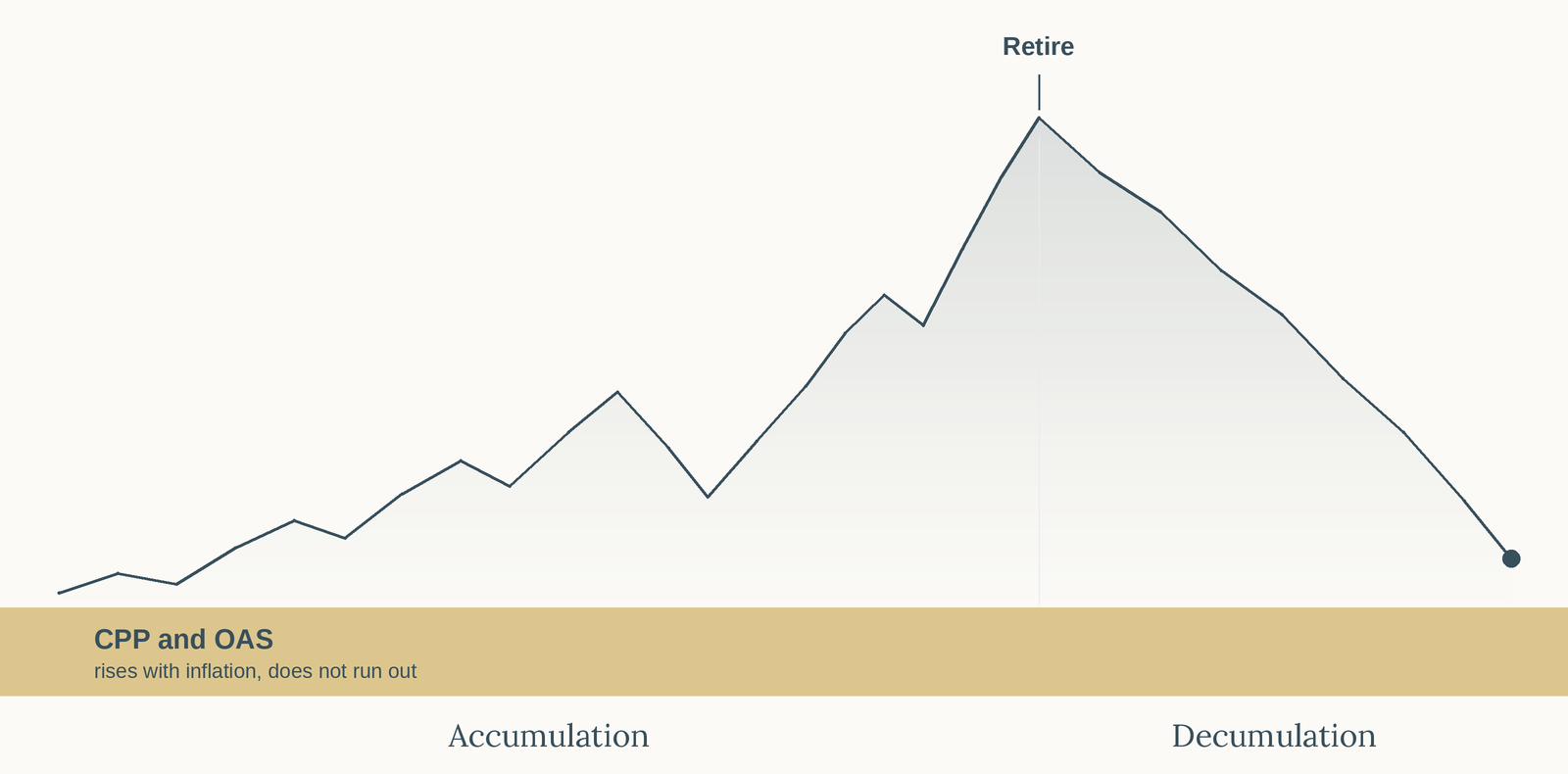
CPP, OAS and GIS all rise with inflation over time. OAS also has a recovery tax, usually called the clawback. Above the annual income threshold, you repay 15 cents of OAS for each additional dollar until the benefit is fully recovered.
What your accounts do on the way out
TFSAs, RRSPs, FHSAs and RESPs are registered accounts with special tax rules. A non-registered account is an ordinary investment account without the same tax advantages or contribution limits.
For retirement savings, the important split is between an RRSP and a TFSA. An RRSP contribution can give you a tax deduction. Regular withdrawals are taxable income. TFSA contributions do not give you a deduction, and withdrawals are generally tax-free.
Your marginal tax rate applies to your next dollar of income, and an RRSP withdrawal sits on top of your other taxable income for the year. The same $10,000 withdrawal can cost different amounts depending on when you take it. The accounts post explains the difference while you're saving, and the TFSA vs RRSP calculator lets you try it with your own numbers.
By the end of the year you turn 71, an RRSP has to change form. You can convert it to a RRIF, buy an eligible annuity, or withdraw the balance and pay the tax. A RRIF can hold the same investments, but a minimum amount has to come out each year starting the following year.
Two risks to a financial plan
Longevity risk is the chance that your money runs out before you do. Calling a long life a risk sounds backwards, but it is why a retirement plan is built to a long age rather than an average one.
Sequence-of-returns risk means that the order of your investment returns matters. Two people can retire with the same amount and earn the same average return, yet have very different results if one meets a bad market early. Selling investments while prices are down leaves less invested when the market recovers.
The words for the plan itself
Decumulation is the financial industry's word for turning savings into spending without running short. It is the reverse of accumulation, which is putting money in.
Your withdrawal rate is the percentage of your portfolio you take out each year. The 4% rule is a common starting point, but the right number depends on retirement length, investment mix and spending flexibility.
Your drawdown order is the order in which you use your accounts. Starting with an RRSP, a TFSA or both can change your tax bill and income-tested benefits.
An annuity trades a lump sum for scheduled payments from an insurance company, often for life. It is roughly the shape of CPP, bought privately.
Where the series goes next
The next posts will cover what CPP and OAS pay, how account withdrawals are taxed, when to take CPP, and what to hold as retirement gets closer. The series will end with a harder question: how do you give yourself permission to spend money you spent decades saving?
Which of these words has been in your way?
If one of these terms is the one you've nodded along to without being quite sure of, I'd like to hear it. Mine was sequence-of-returns risk for an embarrassingly long time. If I missed one, tell me. The terms that come up more than once may become their own posts.
This is general financial education, not individual advice. Program rules, contribution limits and tax rates change, so confirm current figures with Service Canada and CRA. For advice specific to your situation, talk to a qualified professional.
Get new posts by email
Subscribe to The Smallbird Brief and I'll send new posts straight to your inbox.