Last week I made the case that a low-cost index fund is the best starting point for most people. I also made a claim I owe you the reasoning for: that most active funds lose to a simple index over time. This is that post.
First, a quick definition. An active fund is one where a professional manager picks and trades investments, trying to beat the market. An index fund does the opposite. It just holds the whole market and keeps costs low. The active manager is betting they can do better than average. The index fund settles for average, on purpose.
Here is the surprising part: average wins most of the time.
It starts with simple arithmetic
Before you look at a single study, there is a piece of logic that is hard to argue with.
All the investors in a market, added together, own the whole market. So as a group, they earn exactly the market's return, before costs. The active funds and the index funds are drawing from the same pot.
That means, before costs, the average active dollar and the average index dollar earn the same thing. Once you subtract costs, and active funds cost far more to run, the average active dollar has to earn less. Not because the managers are foolish, but because it cannot be any other way. This is arithmetic, not opinion.
What the data shows
Standard and Poor's is the company behind the S&P 500, the index that tracks 500 of the largest U.S. companies and that millions of people already invest in. They also run a scorecard called SPIVA that compares active funds against their benchmark index. In the most recent Canadian edition, 98.8 percent of Canadian equity funds underperformed the S&P/TSX Composite over the ten years ending in 2025. Fewer than two in a hundred kept up with a plain index fund over a decade.
That is not a fluke year. The same pattern shows up year after year, in Canada and abroad.
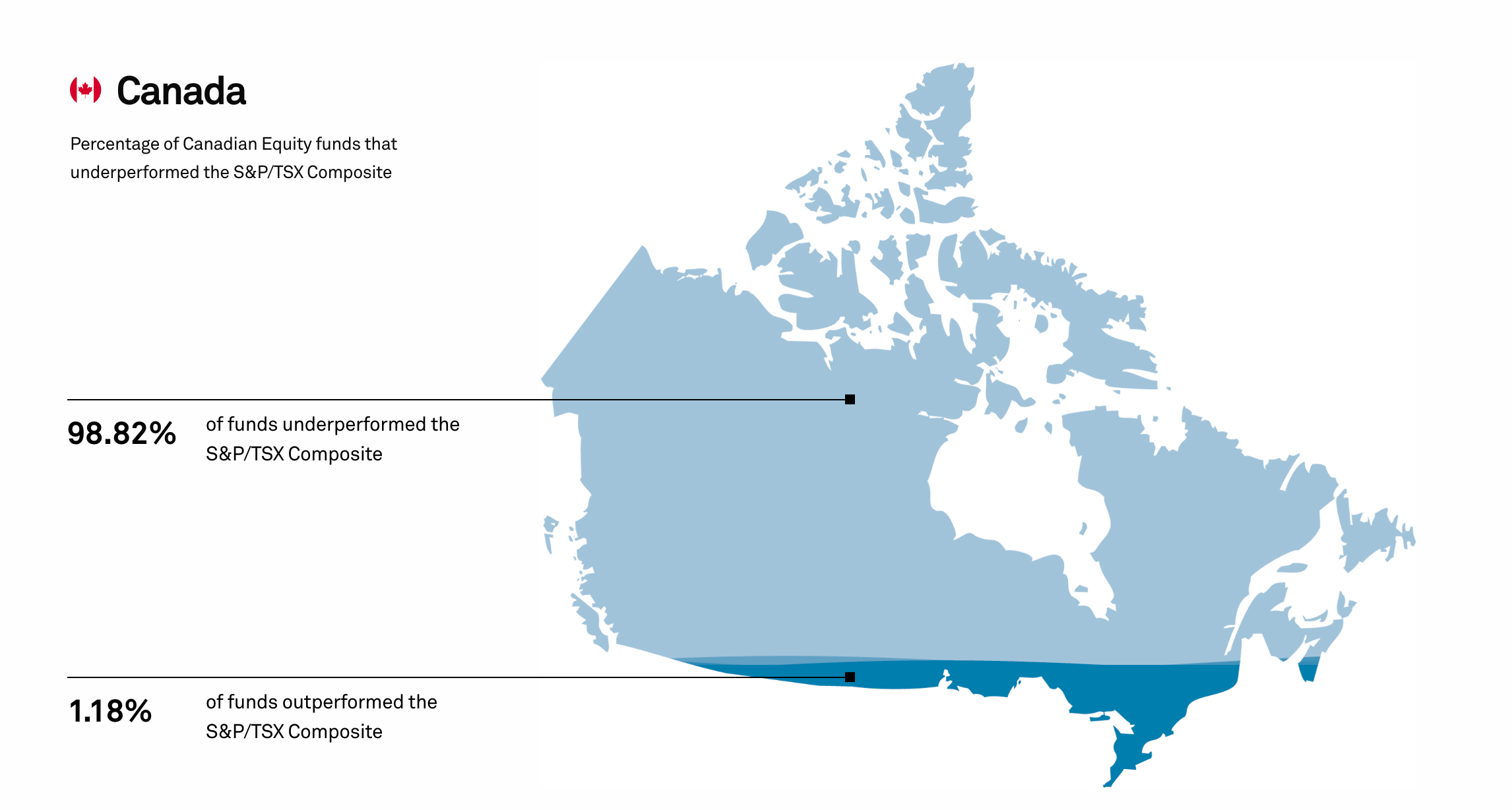
Chart: S&P Dow Jones Indices, SPIVA Canada Scorecard.
But can't I just pick a fund that beats it?
This is the natural comeback, and it is often what an advisor at your bank will tell you. They will usually agree that most funds trail the index, then say the ones they put you in are the ones that beat it. Some funds do beat the index. So why not just buy those?
The trouble is that yesterday's winners rarely stay winners. When researchers track the top-performing funds, most of them fall back to the pack in the years that follow. The funds that stay consistent tend to be the poor ones, which keep underperforming until they get shut down or merged away.
So picking last year's winner is not a reliable plan. You are usually paying a premium for a result that won't last.
Why this is good news
It would be discouraging if beating the market were possible but just took hard work. The reality is easier to live with. You do not need to find the rare winning fund, time your trades, or outsmart the professionals. You are allowed to skip that whole game.
An index fund lets you take the market's return at a fraction of the cost, and history says that beats most of the people trying much harder. Low cost, broad diversification, and patience do most of the work.
That is why boring usually wins. Not because effort never pays off, but because in investing, the simplest approach is the one most likely to leave you better off.
What's next
The single biggest reason active funds fall behind is cost. A percent or two a year sounds small, but over an investing lifetime it adds up to a shocking amount. Next week we'll put real numbers on it and look at the real cost of a 2 percent fee over a lifetime. You can run your own numbers anytime with the calculators at smallbirdfinancial.ca.
This is general financial education, not individual advice. The right approach for you depends on your goals and timeline, so talk to a qualified professional about your own situation.
Get new posts by email
Subscribe to The Smallbird Brief and I'll send new posts straight to your inbox.