
What each account costs you on the way out
Last week added up the floor that CPP and OAS put under your retirement, about $19,550 a year for someone with an average CPP and a full OAS. Everything above that floor comes out of your own accounts, and the same withdrawal can cost you very different amounts depending on which account it comes from.
To keep the comparison fair, I'll use one withdrawal the whole way through. Say you need $10,000 this year, for a new roof, a trip, or just the gap between your pensions and what you spend.
The RRSP: every dollar counts as income
When you contributed to your RRSP you got a deduction, so that money was never taxed on the way in. The bill comes due on the way out. The full $10,000 is added to your income for the year, on top of CPP, OAS and anything else you earn, and it is taxed at your marginal rate.
The first thing you'll notice is that the bank doesn't hand over the full $10,000. It withholds tax and sends it to CRA for you. Outside Quebec, CRA sets that withholding at 10% on a withdrawal up to $5,000, 20% on a withdrawal over $5,000 up to $15,000, and 30% on anything over $15,000. Your $10,000 falls in the middle band, so $2,000 is withheld and $8,000 lands in your chequing account.
That $2,000 is a prepayment, and the real tax is settled when you file. If your marginal rate that year is 30%, the withdrawal costs $3,000 in total and you owe another $1,000 in April. If your rate is 20%, the withholding covered it. Splitting the money into two $5,000 withdrawals only lowers what is taken up front. You owe the same tax either way.
I'm using round rates like 20% and 30% to show how it works. Your own rate depends on your province and your income that year.
Why the year you take it matters
An RRSP withdrawal stacks on top of everything else you earn, so the same $10,000 costs more in a high-income year and less in a low one. Taken while you're still working full time, it sits on top of your salary. Taken in your early 60s, after you've stopped working but before CPP and OAS start, it might be taxed at the lowest rate you've paid since school.
RRSP and RRIF withdrawals can also cost you more than the tax, because they count as income for the OAS clawback and for GIS. For someone close to either line, an extra dollar out of the RRSP can shrink a benefit on top of the tax it triggers. That is a big part of why the order you use your accounts in matters. It gets its own post later in the series.
Once your RRSP becomes a RRIF
By the end of the year you turn 71, your RRSP has to become a RRIF, an annuity, or cash. The tax works the same way in a RRIF, but a minimum now has to come out every year, starting the year after you convert. At 71 that minimum is 5.28% of what the RRIF was worth on January 1, and the percentage climbs each year after. On a $300,000 RRIF, that is $15,840 of taxable income at 71 whether you need it or not.
No tax is withheld on the RRIF minimum itself, only on anything you take above it, although you still owe the tax when you file. And from 65, RRIF income counts as pension income, so you can claim the federal pension income amount on up to $2,000 of it and split it with a spouse on your tax returns.
The TFSA: nothing to pay
You funded your TFSA with money you had already paid tax on, so nothing is owed when it comes out. Take out $10,000 and you get $10,000. Nothing is withheld, nothing appears on your tax return, and it doesn't count as income for the OAS clawback or for GIS.
Whatever you withdraw from a TFSA is added back to your contribution room on January 1 of the following year, so you can put it back later if you have the money. The TFSA room calculator tracks this for you.
If you invest your RRSP refund and your tax rate is the same going in and coming out, a TFSA and an RRSP end up with the same after-tax money, which the TFSA vs RRSP calculator shows with your own numbers. What the TFSA adds in retirement is income that moves neither your tax bracket nor your benefits.
The non-registered account: only the growth is taxed
A non-registered account is a regular investment account with no special tax treatment. You pay tax along the way on interest and dividends each year, and when you sell, only the gain is taxed.
Say the $10,000 you sell is $4,000 you originally put in and $6,000 of growth. The $4,000 comes back tax-free, because it was already your after-tax money. Half of the $6,000 capital gain is taxable under the current rules, so $3,000 is added to your income. At a 30% marginal rate that is $900 of tax on a $10,000 withdrawal, where the RRSP cost $3,000 at the same rate. Nothing is withheld, so the whole bill arrives at tax time.
That $3,000 of taxable gain still counts toward your net income, so a large sale can touch the clawback or GIS. It just touches them far less than an RRSP withdrawal of the same size.
The same $10,000, three ways
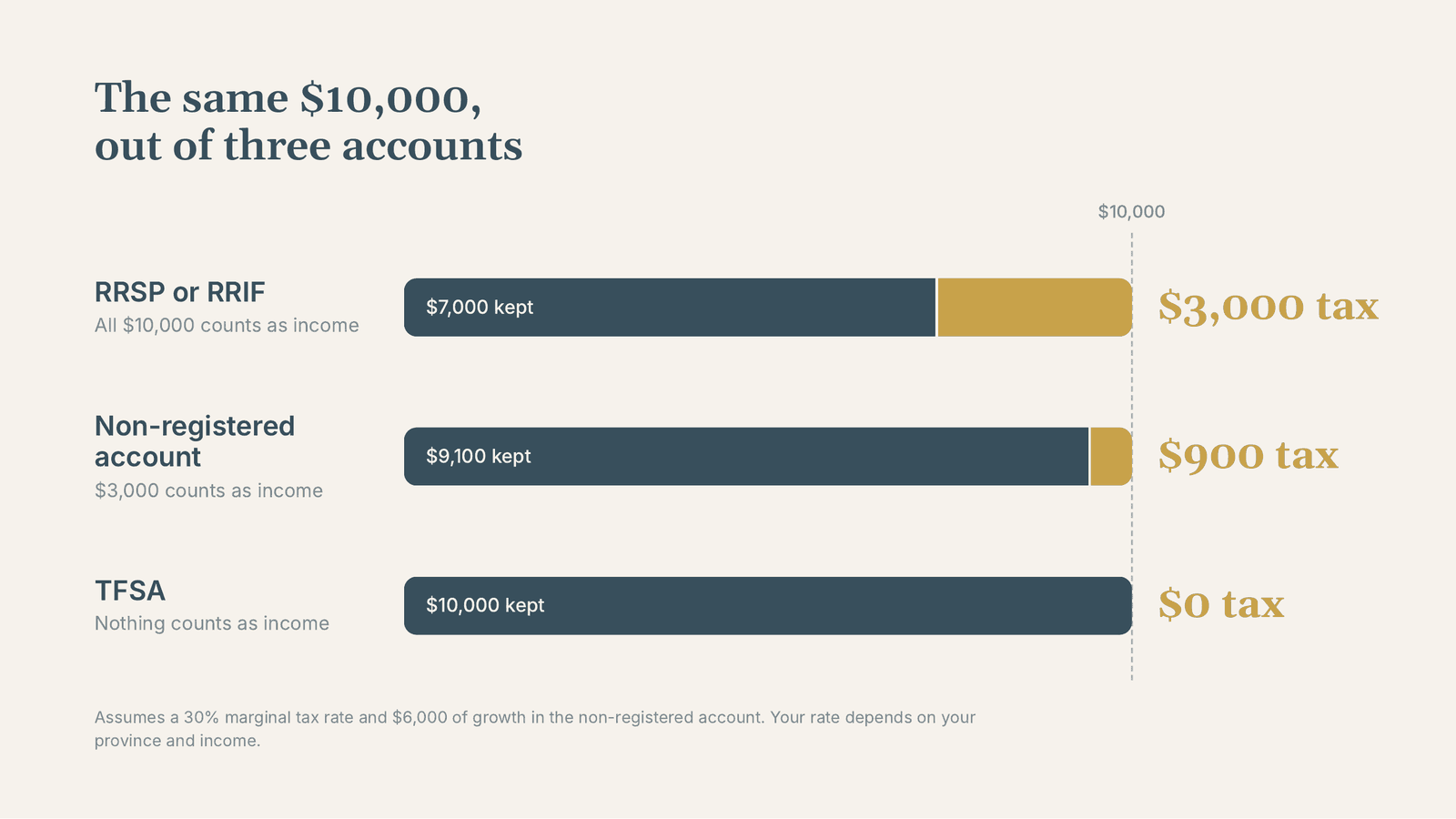
At a 30% marginal rate, with the growth split above:
- RRSP or RRIF: about $3,000 of tax, and all $10,000 counts as income.
- Non-registered: about $900 of tax, and $3,000 counts as income.
- TFSA: no tax, and nothing counts as income.
None of this makes the TFSA the account to spend first. The RRSP has to come out eventually, and leaving it untouched can push you into higher brackets later, once the RRIF minimums start forcing money out. Which account to draw from first, and in which years, is Part 6.
For now, the useful habit is remembering that every dollar you've saved carries a tax bill, and the size of that bill depends on the account it sits in. A $300,000 RRSP is not $300,000 of spending money. A $300,000 TFSA is.
What's next
CPP can start any time from 60 to 70, and every year you wait makes the monthly payment bigger. Next week looks at why waiting is often worth more than the headline increase suggests, and who should take it early anyway.
This is general financial education, not individual advice. Withholding rates, the capital gains inclusion rate, RRIF minimum factors and benefit thresholds are set by the federal government and can change. The figures above are the ones CRA publishes for 2025 and 2026, and Quebec has its own withholding rates. For advice specific to your situation, talk to a qualified professional.
Get new posts by email
Subscribe to The Smallbird Brief and I'll send new posts straight to your inbox.