
When to take CPP (and OAS)
Last week went through what each account costs you on the way out, and the week before added up the floor that CPP and OAS put under your retirement. That floor isn't a fixed size. When you start each pension decides how big it is for the rest of your life, and CPP gives you a ten-year window to choose from.
How the CPP dial works
You can start your CPP retirement pension any time from 60 to 70. Start before 65 and the payment shrinks by 0.6% for every month you're early, so starting at 60 cuts it by 36%. Start after 65 and it grows by 0.7% for every month you wait, which adds up to 42% at 70. Waiting past 70 adds nothing.
Whichever age you pick, the change is permanent, and the amount you start with is indexed to inflation every January and paid for the rest of your life.
The same person at 60, 65 and 70
Take someone whose CPP at 65 would be $858.34 per month, the average for people starting at 65 as of July 2026.
- Start at 60: about $549 per month, or $6,590 per year.
- Start at 65: about $858 per month, or $10,300 per year.
- Start at 70: about $1,219 per month, or $14,630 per year.
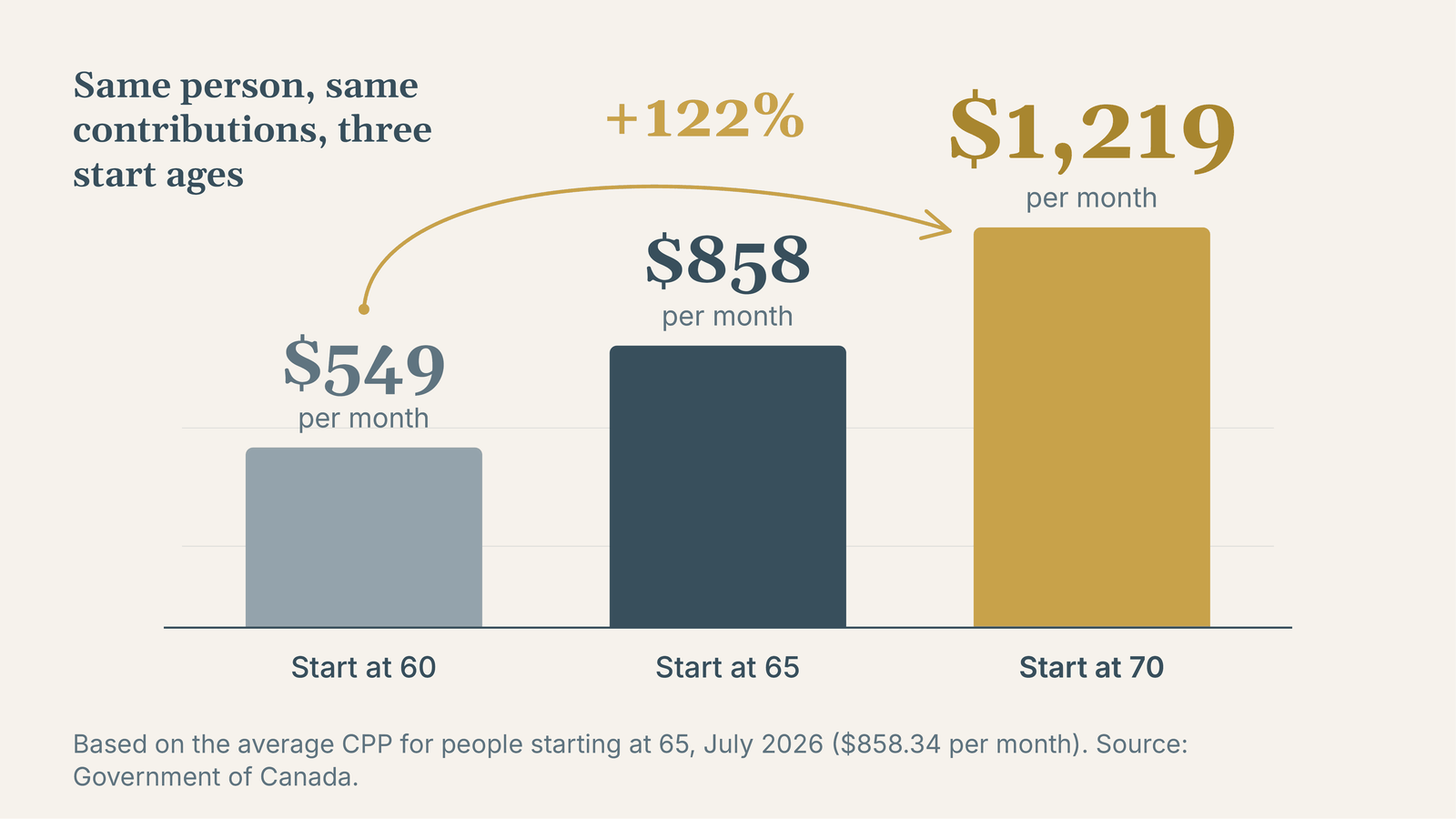
Most people weigh this decision from 65, where waiting looks like a 42% raise. But the choice opens at 60, and measured from there, waiting until 70 gets you a payment about 122% larger. That's more than double the cheque, for life, from the same contributions.
The headline also leaves out something that works in your favour. Until you start, your CPP is tied to average Canadian wages, which have usually risen faster than prices, so the 42% gets applied to a base that kept growing while you waited. If you stop working well before 65, the extra years with no earnings can pull that base down a little, even though CPP drops your lowest eight years from the calculation. If you're retiring early, run your own numbers before counting on the full boost.
Why "what if I die early?" is the wrong worry
The objection I hear most is that waiting only pays off if you live long enough to collect, and that's true. Ignoring inflation and growth, someone who waits from 65 to 70 has to live to about 82 before the bigger payments catch up with the five years they skipped. Someone who waits from 60 to 70 has to reach about 78.
CPP is insurance, though, and insurance is judged by what happens in the bad case. If you wait and die at 75, you left some CPP uncollected, but at that point you have a bigger problem on your hands. If you start at 60 and live to 95, you spend more than thirty years on the smallest version of the one income that can't run out. For a 65-year-old couple, the second of them lives on average about 25 more years, to nearly 90. Roughly one couple in twenty has someone still going at 100.
Personally, I'm planning to take CPP as late as I can. I like the idea of betting on myself to live a long time, and it gives me one more reason to look after my health now.
Who should take it early anyway
Waiting is the better deal for most healthy people with savings to bridge the gap, but starting earlier makes sense if any of these fit you:
- Your health is poor, or you have good reason to expect a shorter life.
- You have no other savings to live on until a later start, and waiting would mean debt.
- Your income in retirement will be low enough for GIS, the Guaranteed Income Supplement. CPP counts against GIS, so for a single person each extra dollar of CPP costs about 50 cents of GIS, and more at the lowest incomes.
If an advisor is steering you toward CPP at 60, ask why. An advisor paid a percentage of the assets they manage earns more when your savings stay invested, and starting CPP early is one way to keep them there. That doesn't make the advice wrong, but the reasoning should hold up without it.
OAS works the same way, with one trap
OAS can't start before 65, but you can delay it up to five years, and each month you wait adds 0.6%, up to 36% more at 70. At the current maximum of $762.50 per month (October to December 2026), that's about $9,150 per year at 65 against $12,440 per year at 70, before the indexing that happens every quarter.
The trap is GIS, which is only paid to people receiving OAS. While your OAS is deferred your GIS is too, and GIS doesn't grow with the delay. For a single person this quarter it's worth up to $1,138.90 per month, so someone whose income will be low enough to qualify can give up years of it that never come back. If GIS is part of your picture, OAS at 65 is usually the better choice.
Paying for the wait
Waiting until 70 means living on something else in the meantime, and for most people that's the RRSP. The years after you stop working and before CPP and OAS begin are often the lowest-income years of your adult life, which last week's post showed makes them the cheapest years to take RRSP money out. Every dollar you draw then is a dollar the RRIF minimums can't force out later, on top of a bigger CPP.
So you aren't choosing between spending your savings and keeping them. You're using money that was going to be taxed anyway to buy a larger pension that's indexed to inflation and guaranteed for life, which nothing you can buy privately matches on price.
Your own CPP estimate is in My Service Canada Account, and if you'd like to see your numbers at 60, 65 and 70 side by side, with the bridge years planned out, that's something we can work through together.
What's next
Waiting pays off only if you live long enough, which raises the obvious question of how long to plan for. Next week's post looks at why planning to an average age leaves about half of people short.
This is general financial education, not individual advice. CPP, OAS and GIS amounts and adjustment rates are set by the federal government and change quarterly or annually; the figures above are the ones published for 2026, and the break-even ages ignore inflation, wage growth and investment returns. Confirm your own numbers with Service Canada and your My Service Canada Account. For advice specific to your situation, talk to a qualified professional.
Get new posts by email
Subscribe to The Smallbird Brief and I'll send new posts straight to your inbox.